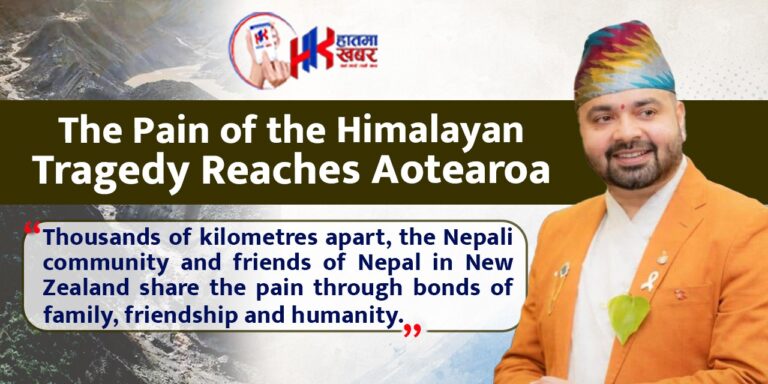
– Dr Ramil Adhikari | Upper Hutt, New Zealand
For many people in New Zealand, the devastating floods and landslides along the Nepal–Tibet border are anything but a distant tragedy. Across Aotearoa, particularly within the Nepali community and among New Zealanders who have travelled to Nepal or developed deep personal connections with the country, the unfolding disaster is being felt with profound sadness and concern.
Nepal and New Zealand may be separated by thousands of kilometres, but their relationship has always extended far beyond geography. It has been shaped by friendship, tourism, education, community ties and a shared history that carries the enduring legacy of Sir Edmund Hillary and the people of the Himalayas.
Today, that connection has taken on an especially painful meaning as families wait anxiously for news of loved ones.
The disaster unfolded on Wednesday when a powerful surge of water, mud and debris swept through areas near the Nepal–Tibet border. Initial reports raised concerns about an earthquake, while subsequent assessments by the United States Geological Survey indicated that the event was associated with a glacial collapse, resulting in catastrophic downstream impacts.
The force of the water and debris caused extensive destruction, sweeping away buildings, roads and vehicles and leaving communities isolated. Nepalese security personnel, civilian responders and other rescue teams have been working under extremely difficult conditions to reach affected communities and travellers.
According to figures provided by Nepalese authorities, 389 people have died in Nepal, while approximately 910 remain missing, including five New Zealanders and 39 Australians. Those reported missing include foreign nationals as well as personnel from the Nepal Army and Nepal Police.
Across the border in Tibet, Chinese authorities have reported three confirmed deaths and 558 people missing, including foreign nationals. The figures reported by the authorities in Nepal and China may not directly correspond, and assessments of the scale of the disaster remain ongoing.
Adding to the concern, reports indicate that a significant body of rising water has formed near the China–Nepal border, close to the Gyirong area. With rainfall continuing, authorities remain concerned about the possibility of further flooding, creating an additional threat for communities already affected by the disaster.
For the Nepali community in New Zealand, however, these figures are not simply numbers.
Behind every missing person is a family waiting for a phone call. Behind every number is a human life, a friendship and a story. Across Aotearoa, many Nepali families have relatives and friends in Nepal, while numerous New Zealanders have travelled through the country’s mountains, experienced its renowned hospitality and formed friendships that have lasted for decades.
The tragedy therefore resonates across both communities.
New Zealand has a particularly special place in Nepal’s modern history. The friendship forged through Sir Edmund Hillary’s extraordinary work with the Sherpa people and his contribution to communities in the Himalayas remains one of the strongest symbols of the bond between the two countries.
Hillary’s legacy was never simply about climbing Mount Everest. It was also about partnership, service, education and community development. That spirit of friendship continues today through the thousands of Nepali people who have made New Zealand their home while maintaining strong cultural, family and emotional connections with Nepal.
In Upper Hutt and communities across Aotearoa, Nepali families and friends are watching the situation with heavy hearts. Many are hoping for positive news as rescue and search operations continue.
The challenges facing rescuers are immense. Unstable terrain, continuing rainfall, damaged infrastructure and the possibility of further flooding are making access to affected areas extremely difficult. Yet the determination of rescue personnel and local communities remains a powerful source of hope.
At a time of such profound uncertainty, what matters most is the safety of those still missing, timely rescue of those who can be reached and meaningful support for families who have lost loved ones.
This is also a moment for the wider international community to stand with Nepal and the affected communities in Tibet. Natural disasters know no borders, and neither does human compassion.
The tragedy unfolding in the Himalayas is a painful reminder that behind every disaster statistic are individuals, families and communities whose lives can change in an instant.
From Aotearoa to the Himalayas, the distance may be vast, but the bonds of friendship, family, culture, tourism and shared humanity remain remarkably strong.
At this difficult hour, the thoughts and solidarity of people across New Zealand are with the people of Nepal and Tibet, the families who have lost loved ones, those still waiting for news, and the rescuers working tirelessly in some of the most challenging conditions imaginable.
May those still missing be found safely, and may the affected families and communities find strength, support and hope in the days ahead.
(Adhikari, Tourism Ambassador for Pokhara Metropolitan City to New Zealand and the Oceania Region)

प्रतिक्रिया